|
BCCP: The Journey Begins
Since its formation in 1996 BCCP, as the successor to the Johns Hopkins Bloomberg School of Public Health/Center for Communication Programs (JHU/CCP), has been making impressive strides by designing, managing, implementing, monitoring and evaluating large-scale communication programs for various development sectors in the country.
BCCP Offers “One-Stop” Services
BCCP’s team with a cluster of highly qualified and experienced Strategic Communication professionals offer "One-Stop" communication services. The services combine the science of a data driven process with the art of creative programming that follows a systematic research-based planning tool pioneered by JHU/CCP which is known as "P Process" .

This process continues to supplement BCCP's expertise that can be categorized as:
- Developing comprehensive national communication strategies
- Implementing media campaigns
- Advocating effective and target-specific programs at all levels
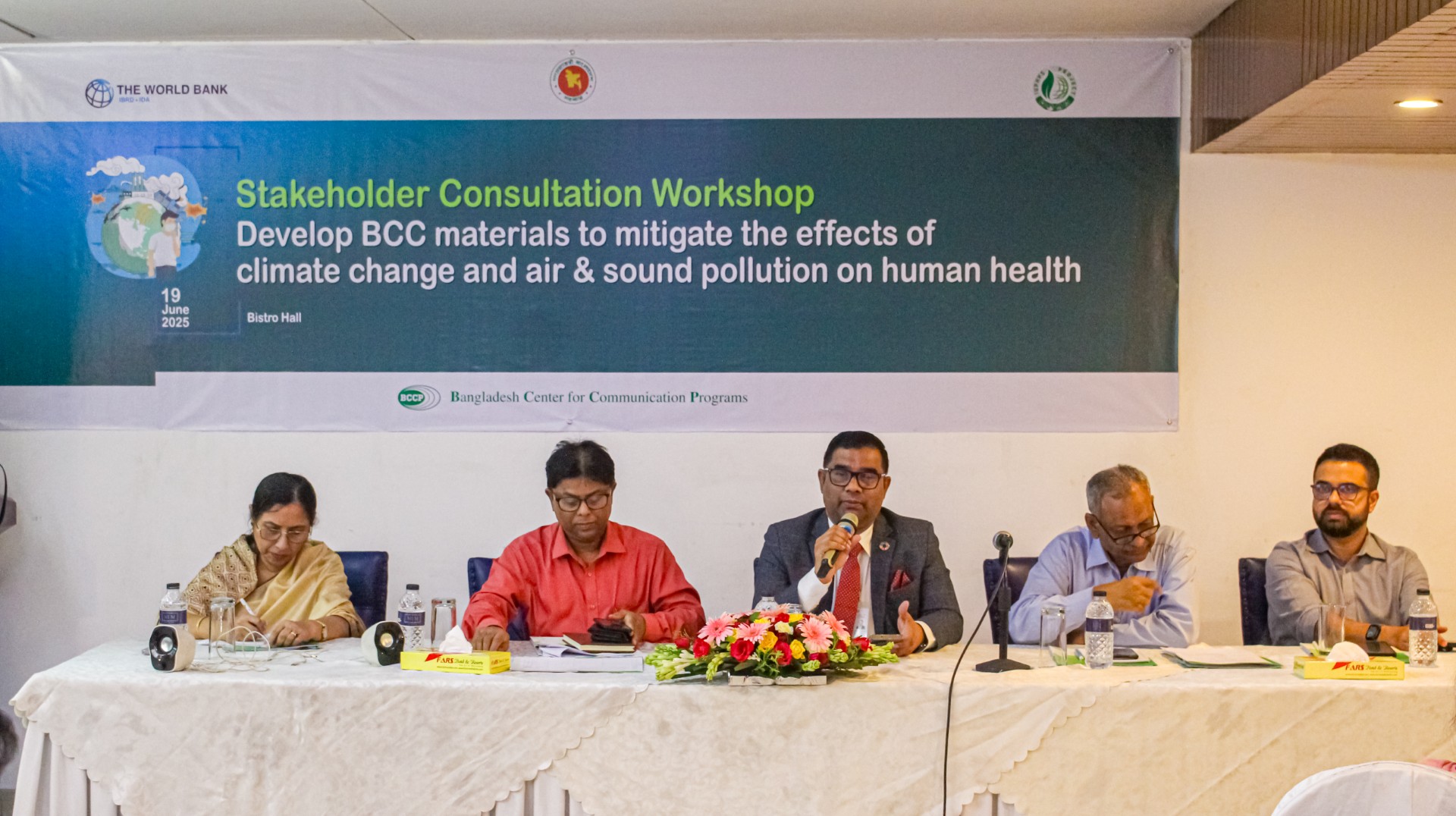
- Conducting communication training programs and workshops
- Developing communication materials
- Facilitating collaboration among NGOs, public and private sectors
- Leveraging resources to extend the reach of programs
- Conducting formative and evaluative research
- Monitoring national and community-based activities
Communication Strategies
Strategic Communication requires formulation of communication strategy outlining the objective and rational use of mass media, new technologies, social networking and community approaches which is BCCP's specialty. It has developed several communication and advocacy strategies for different development programs. National FP-MCH IEC Strategy for Bangladesh 1993-2000, National HIV/AIDS Communication Plan; National Tuberculosis Control Program Communication Strategy, BCC Strategy for Medical Education for Essential Health Services; National Health Education and Promotion Strategy are some examples of national strategies formulated by BCCP for GoB. The other strategies implemented by donors and NGOs are National BCC Strategy for NGO Service Delivery Program, National Communication Strategy to Combat Trafficking in Person in Bangladesh, Adolescent Reproductive Health Communication Strategy, Communication Strategy for National Network of Union Parishad, etc.
Mass Media
Optimizing the growing reach of the media in Bangladesh, BCCP promotes "brand building" and "category building" campaigns combining creativity, research on media habit, cultural and behavioral pattern of the target audience and addressing the sensitivity of the issue. The implementation includes holistic approach using print, electronic and outdoor media.
Advocacy and Social Mobilization
National Family Planning Program, National Advocacy and Communication Components of HIV and AIDS Prevention Program, Adult Women Education Program, Local Level Advocacy Program on HIV/AIDS, Mainstreaming of HIV/AIDS Program, National Tuberculosis Program, etc. required different approaches to garner political commitment and policy change, mobilize human and financial resources; enhance capacity of communities to obtain, adapt and generate knowledge for "building constituency" and regenerating "peoples' voice". The "Jiggasha Approach", Future Search Conference, Local Level Planning Meeting, Sensitization Workshop, Life Skills Workshop, etc. have proven to be effective in these programs. The approach appropriately uses motivational video, live telecasting of the Enter-Educate dramas and other popular folk media.
Enter-Educate Approach
The Enter-Educate Approach refers to education through entertainment. The popular drama serials produced by BCCP - Shabuj Shathi, Shabuj Chhaya, Eyi Megh Eyi Roudro, Enechi Shurjer Hashi, etc. combined entertainment with useful health messages that catered to the hearts and heads of millions. This approach added staying power to the messages and persuaded people to increasingly seek health services. Jante Chai Janate Chai and Amra Shobai Jante Chai are radio programs which were designed exclusively for adolescent boys and girls to help them develop morally and acquire a positive outlook on life.
Communication Training
BCCP continues to organize the annual international Advances in Communication Workshop. The workshop integrates theory and practice through the use of interactive Strategic Communication Planning and Evaluation (SCOPE) software. It also conducts Message Development Workshop twice a year. These training programs capacitated more than 500 mid-to-senior level program managers and policy-makers to successfully develop and implement health and social communication interventions including message and material development, Interpersonal Communication and advocacy.
BCC Material Production
Message and material development is considered as an integral part of Strategic Communication and the process involves conceptualization and development of the message, creative work, technical review, pre-testing, finalization and production. BCCP has an efficient creative section comprising of a group of creative people and modern equipment.
Research and Evaluation
The research team guides designing of the communication programs, monitors and evaluates impact. BCCP has further strengthened its research team to manage and conduct large scale research studies, both qualitative and quantitative. KABP and formative research are also conducted to explore program development, observe behavior pattern; understand knowledge, perception, and practice of the target audience; assess communication and training needs; and, pre-test messages and materials.
Resources
BCCP has a Media Material Center (MMC) and a Photo Bank to serve the NGOs, partner agencies and donors according to their communication needs. Specimen of all communication materials produced by BCCP are archived and exhibited in the MMC. Its forte is its modern high-tech apparatus support. In the Photo Bank, photographs along with their negatives are systematically preserved so that anything can be retrieved as and when required within a short period. BCCP also has access to the communication resource of JHU/CCP.
The Vision
It is BCCP's vision to have an empowered and enlightened Bangladesh free from poverty and exploitation based on age, sex and religion. BCCP plans to continue with its mission of meaningful contribution to the improvement of social behavior through more innovative, strategic and dynamic programs in future.
|